
HOW TO SIMPLY IDENTIFY A DAMP HOUSE
Buyers of both renovated and unrenovated houses should watch for damp, which can cost thousands of dollars to fix. Damp walls or a damp sub‑floor shouldn’t stop a purchase, because most problems can be rectified. Buyers should investigate the property to reduce the risk of unexpected losses caused by vendor cover‑ups. A survey by the Royal Australian Institute of Architects, Archicentre Advisory Service, and the University of Melbourne found that 45% of solid brick houses over 70 years old, and 25% of houses aged 50–70 years, had rising damp.
Rising damp isn’t limited to solid brick houses. Weatherboard homes often develop it in their brick chimneys, so buyers have a high chance of finding damp in an inner‑suburban property.
Dampness can cause health problems, including mould, bacteria, and airborne infections. It also encourages insect attack, creates odours, and makes a house cold and expensive to heat.
Renovators should follow the sequence:
- Fix the roof
- Fix the drainage
- Fix the sub-floor ventilation
- Fix the rising damp
- Re-plaster after drying of the walls and then start renovating.
It is an unfortunate fact that this rarely occurs. Prospective purchasers can follow a simple inspection procedure to identify sources of dampness.
OVERVIEW
An overview of the house’s problems can be established by inspection for –
- Water Run Away
- Underfloor Ventilation For Suspended Timber Floors
- Fix the sub-floor ventilation
- Bridging Of Present Damp-Proof Course and Presence of Concrete
- Penetrating Damp
Water Run Away
Roof downpipes, spouting and waste pipes should clear water from the site. If stormwater is running into the earth or into spoon drains this is a source of moisture, which could be draining under the house, causing dampness under the floors and deterioration of timber floors.
Underfloor Ventilation For Suspended Timber Floors
In wet soil conditions the building needs one double ventilator for every 1.5 m of wall length around the entire building perimeter.
All present vents should be clear. If a building is in a damp area and had insufficient sub-floor ventilation in the past, then the timber floors and stumps could be in poor condition. Terra cotta vents as in Edwardian houses are very poor ventilators and are part of the cause of floor problems in such buildings. (See Figure 1)
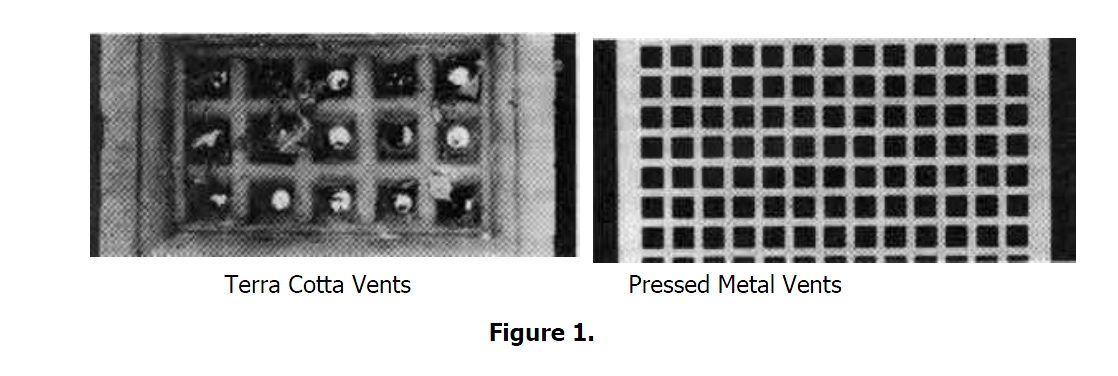
Ideally the earth level under the house should be at the same level as the earth outside the walls so that drainage to under the house does not occur. The earth level under the house should be well under floor level to give adequate sub-floor airflow. Inspect the sub-floor area in as many locations-as possible (shine a torch through vents). Should there be a white-cream fungus material growing on the soil or on the bricks then the sub-floor area is very damp. In the worst case, if there is a fruit-like fungus with cotton wool-like strands on woodwork, this is dry rot infection.
Should one be able to inspect the sub-floor area there should be adequate double brick openings in the brickwork below floor level. These should be beneath doorways and within 1-2 m of the corners of each room and every 1.5m along walls. The openings should be near the ground.
A common renovation practice in older buildings is to ignore the need for adequate sub‑floor ventilation to existing timber floors and to replace part of the timber flooring with concrete. The new concrete blocks ventilation to the remaining timber floors, increasing the risk of insect and fungal attack and shortening their lifespan. The junction where the timber floor meets the concrete is particularly vulnerable. An additional problem is that the fill under the new concrete may fill over the old damp course or bluestone and cause rising damp in the walls.
Be aware that if the building has ducted heating installed, the ducts could be blocking the sub-floor space and as such could cause significant floor problems. Hydronic heating would be preferred.
Bridging Of Present Damp-Proof Course and Presence of Concrete
In Victorian buildings, builders tried to prevent rising damp by using bluestone—an impermeable material—for the footings and placing a damp course (such as coal tar, bitumen and sand, or slate) in the mortar line directly above it. In higher‑value buildings, large bluestone pitchers formed the footings, so moisture could only travel up the mortar lines. Builders of lower‑value buildings often used bluestone rubble with large amounts of lime mortar, giving the damp an easy path upward. Once the moisture reaches the handmade bricks, rising damp becomes firmly established. If earth levels have been raised against bluestone pitcher footings, either inside or outside the house, this encourages damp to rise through the final mortar lines into the bricks
If the bluestone and damp course is bridged then rising damp is the sure result. Bridging could also occur by rendering covering the damp course. (See Figure 2.)
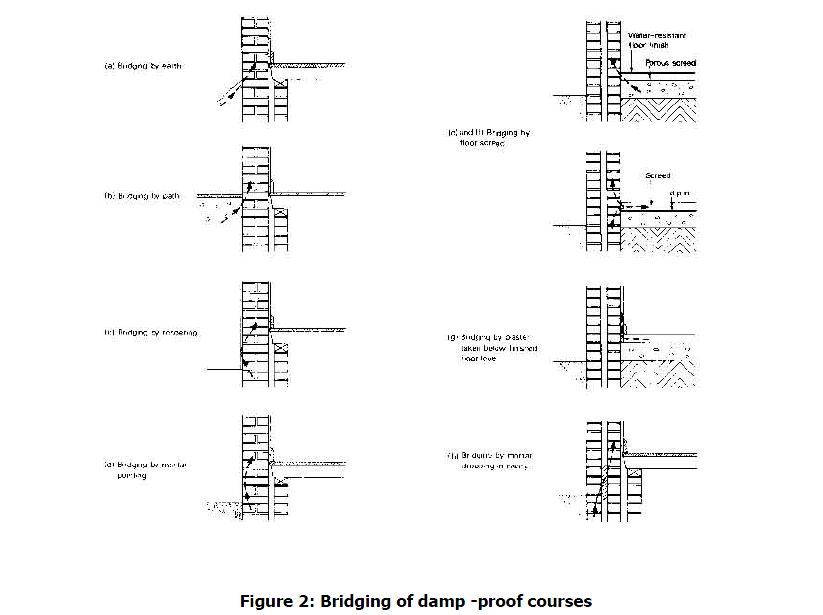
In Edwardian buildings, you’ll usually find the damp course, typically bitumen and sand, located at the mortar line at the top and bottom of the vents. Because sand was added to prevent the bitumen from extruding, this type of damp course is not fully impermeable. It still performs adequately in mild conditions, where some moisture rises through the first damp course but is mostly stopped by the second (top) damp course. However, if the bottom damp course becomes bridged, leaving only the top layer exposed, significant rising damp can occur.
Concrete present either inside or outside the building may cause problems due to bridging of the damp course by the fill under the concrete. In addition in damp locations the earth under the concrete can become very damp and cause rising damp in the walls where the old damp course in the walls is not sufficiently effective to stop it.
Penetrating Damp
Check for penetrating damp coming through the masonry, especially on the weather‑exposed side of the building. Sandblasted bricks often allow significant moisture ingress because weakened mortar lines and increased brick permeability let water in. You can usually fix this by re‑pointing the mortar lines and deeply impregnating the bricks with a long‑life siloxane water repellent.
INSPECTION OF THE BUILDING FOR RISING DAMP
Unrenovated Buildings
This case, where a building has not been recently decorated, is the easier to survey. The symptoms of dampness, some or all of which may be present, are:
Inside
- Paint does not adhere to the wall.
- Wallpaper lifts.
- Stains appear on the walls.
- Mould spots appear on walls, on clothing, on shoes etc.
- Plaster flakes away, feels soft and spongy, bubbles and white powder or crystals appear (efflorescence).
- Room smells musty.
- Skirting boards and floor boards rot
Outside
- Mortar frets and falls out between bricks and stonework.
- Stains appear.
- White powder appears.
From a distance, you can often see a darkened band at the base of the wall. A typical sign of rising damp is a roughly horizontal tide mark: above it, the wall shows little or no damage, while below it the paint or plaster deteriorates or the wallpaper becomes stained or lifts. Damp usually rises no more than 1–1.5 metres up the wall, although in very damp conditions the damage can appear higher.
Move the furniture, which the owner may be using to hide rising damp on the walls.
You can buy a low‑cost moisture meter from reputable building‑product suppliers for about $79. It’s a useful qualitative tool for detecting moisture. Interpret the readings carefully, because hygroscopic salts will always push the numbers higher.
If waterproof render or plaster has been used to hide rising damp, you may see a horizontal line on the plaster showing how high the damp has risen.
Renovated Buildings
Diagnosing rising damp in buildings where waterproof render or plaster has been used to hide it is difficult. The only reliable method is to drive two masonry nails through the plaster and render into the bricks near the floor and take a qualitative reading with a moisture meter. This is rarely practicable in a house that has been renovated for sale.
In general waterproof render and plaster is not a solution to rising damp and will fail sooner or later. It is only logical that what is needed is a positive horizontal barrier to stop the rising damp. A vertical waterproof barrier usually forces the damp higher, out of cracks or out at the base of the wall where the skirting boards rot. There are various means of detecting new plasterwork (possibly waterproof) above the skirting boards:
How to Identify New or Waterproof Plaster
- hammer masonry nails into the plaster – waterproof render needs a high cement mix and will be very hard. This may not be practicable on an inspection.
- inspect the wall and look for a join line of old plaster to the new plaster. A join line may mean that a damp course job has been done and replastering has been carried out. Alternatively it may mean that only waterproof plastering has been carried out. Ask the owner about any work completed and request the name of the contractor. Note that there are very few methods of damp course installation that are successful so investigation of the details of the work is necessary.
- tap the plaster with your knuckles and listen to the tone of the wall from above 2 m from the floor down to the wall at the top of the skirting board. A different tone usually indicates new plasterwork carried out above the skirting board. Waterproof render and plaster is a disaster for the buyers who finally retain the problem in the house. They lose the value of the decoration they have paid for in the house purchase price.
You may need to remove the skirting boards and replace the affected plaster after installing a new damp course or fixing the underlying problem.
New Concrete and Blocked Ventilation
In renovated buildings, search for new concrete at the rear of the building or in other areas. Many renovators pour concrete at the rear of a timber floored building and then place prime cost items such as the kitchen and bathroom in this position. The sub-floor ventilation is interfered with and a buyer cannot easily return to satisfactory sub-floor ventilation without large capital loss.
Carpet Underlay and Trapped Moisture
Another trap for buyers is the underlay under the new carpet. In the unrenovated building there were bare tongue and groove floorboards and possibly felt underlay under carpets. In this case damp air from the under floor area came through the floors and floor coverings into the rooms and eased the dampness under the floors. New carpet laid without fixing the sub‑floor ventilation can trap moisture because the rubber or foam underlay and backed carpet seal the floors. This creates problems. In wet locations, the timber floors can become very damp and deteriorate quickly.