
Guide to Rising Damp
What is Rising Damp / Salt Damp?
Rising damp—also called salt damp—occurs when salty ground moisture rises through brickwork and mortar by capillary action.
In simple terms, the moisture travels up a wall the same way a sponge absorbs water beside a sink or a lamp wick draws oil upward.
The moisture continues to rise until it reaches a point where evaporation slows and gravity pulls it back down. In most cases, rising damp climbs no higher than 1.5 metres above ground level.
Rising damp appears most often in homes over 40 years old, but it can also affect newer buildings when damp‑course protection fails or becomes compromised.
What causes Rising Damp?
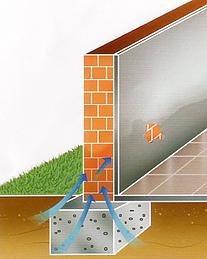
Rising damp problems often occur as a result of not having a Damp Proof Course installed or having a Damp Proof Course that is faulty due to age or inadequate installation. It can also occur when the damp course level is bridged by earth, concrete or other masonry.
A Damp Proof Course is a waterproof layer in your wall (or both walls if you have a cavity wall), ideally about 15cm from the outside ground on your external walls and under your raised timber floor or near your concrete floor on your internal wall (so both DPC’s are on the same level). This layer repels water from rising up the wall.
How to identify Rising Damp?
In houses with rising damp, the following symptoms normally appear
Inside:
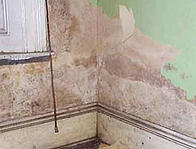
- Rotting window frames, skirting boards or floorboards
- White stains/tidemarks on walls through salt in water
- Bubbling or flaky plaster
- Wallpaper lifts / comes off
- Paint will not stick to the walls
- White powder or crystals appearing on the surface of the walls (efflorescence)
- Moist or wet patches appearing on the walls
- Bad, damp smell
- Mould growth on walls and furniture (but not exclusively – mould is also a product of poor room and/or sub-floor ventilation)
Outside:
- White powder or crystals appearing on the surface of the walls (efflorescence)
- Mortar frets and falls out between bricks and stonework.
- Stains appear
Step to Step Guide how to treating Rising Damp
The installation of a new damp course with Tech-Dry Damp Course Cream
into an existing brick or masonry wall stops rising damp. Here a step to step guid:
STEP 1
Identify the rising damp which exhibits as:
For Internal Walls:
- Peeling & bubbling paint work
- Water tide mark or staining
- Presence of salt on walls
- Flaking plaster & render
- Rotting skirting & floor board
- Musty room smells
For External Walls:
- Fretted brickwork
- Water tide mark or staining
- Presence of efflorescence or sal
- Peeling & bubbling paintwork
- Crumbling bricks & missing mortar
STEP 2
Internal: Carefully remove any skirting boards present to reveal the lowest mortar course just above the floor level.
External: Locate a mortar joint at a position normally 150mm above ground level, or just above floor level so both sides of the wall are evident.
Mark holes at approx. 80mm apart so that 3 holes should be drilled into the mortar bed of each length of brick of approx. 230 mm. Avoid drilling holes directly above the vertical mortar joints of brick walls.
STEP 3
Set the drilling depth at about 10mm less than the wall thickness. Drill 12mm holes into the mortar bed using a hammer drill.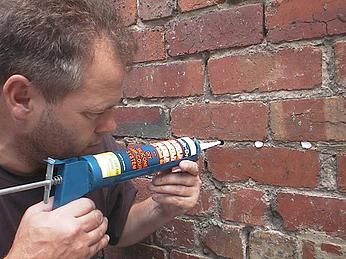
STEP 4
Completely remove all the dust from the holes using a vacuum cleaner fit with a proper adapter that can suck the dust from inside of the holes.
STEP 5
Cut plastic tube to fit wall thickness and fit on end of nozzle of caulking tube.
STEP 6
Inject the DPC cream slowly into each hole using a standard caulking gun. Push the nozzle to the back of the hole, then withdraw it gradually as you fill the cavity. Fill each hole completely and avoid leaving bubbles or hollows.
Consumption: Use 12 ml of cream for a single‑brick wall. This equals 150 ml per metre of single‑brick wall or 300 ml per metre of double‑brick wall per fill.
AFTER TREATMENT:
After 24 hours the cream or fluid is absorbed and there should be a continuous horizontal absorption mark (wet mark) in the treated mortar and bricks above and below the treated mortar bed. If product does not penetrate the middle of two holes, repeat the process using the same holes. The treated wall may take several days to become a water repellent barrier.
Allow wall to dry out completely before further renovation is carried out i.e. 6 months before re-rendering.
For any further questions, contact us here at Tech-Dry!